.png)
Landscape Plans for Planning Permits
Landscape plans are essential documents that demonstrate how outdoor spaces will be designed and managed as part of development proposals in Victoria.
They provide councils with crucial information about site layout, vegetation, hardscaping, and environmental outcomes, and are often a mandatory requirement for certain applications.
What Is a Landscape Plan?
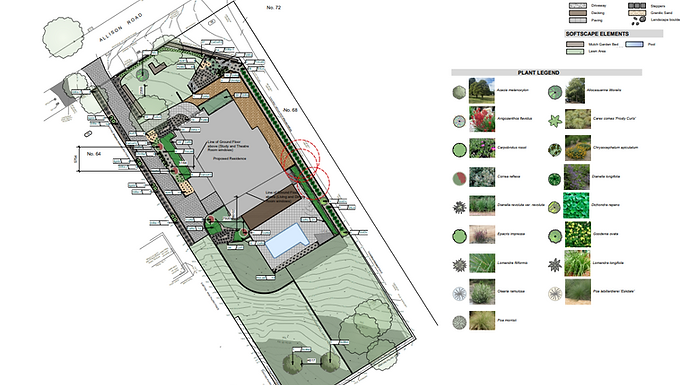
A landscape plan is a detailed visual and written document that outlines the design, layout, and management of all outdoor areas within a development site. It includes information about plant species, trees, hardscaping materials, site grading, drainage, and how the landscape will integrate with the surrounding environment.
For most developments in Victoria, particularly residential subdivisions, commercial projects, and mixed-use developments, a landscape plan forms part of the planning permit application.
The plan must comply with the Victorian Planning Provisions and relevant local planning policy frameworks in your municipality.
Overview of Victoria's Planning Requirements
Victoria's planning system is governed by the Planning and Environment Act 1987, which establishes the framework for land use and development. Landscape plans fall within this broader regulatory structure and must be prepared in accordance with planning scheme requirements specific to each local council area.
When Landscape Plans Are Required
Landscape plans are mandatory for most developments that trigger planning approval, including:
• Residential subdivisions (particularly larger developments)
• Multi-unit residential buildings (apartments, townhouses)
• Commercial and retail developments
• Mixed-use projects
• Industrial facilities with significant site works
• Public buildings and community facilities
• Infrastructure projects requiring landscape integration
Some smaller applications, such as single dwelling houses or minor alterations, may not require a formal landscape plan, but councils often recommend them to improve application outcomes.
Council Requirements for Landscape Plans in Victoria
Different councils across Victoria have varying specific requirements, but most follow consistent principles based on the Victorian Planning Provisions and the Planning Practice Notes.
Here's what councils typically require:
Standard Documentation Components
Requirement Details
Scale and Format Plans must be drawn to an appropriate scale (typically 1:100 to 1:500, depending on site size) and submitted in both hard copy and digital formats (PDF, DWG)
Site Plan A clear layout showing existing and proposed features, including building footprints, roads, pathways, and boundary lines
Vegetation Schedule
A detailed list of all proposed plants and trees, including botanical and common names, quantities, heights at maturity, and planting specifications
The below summarises typical landscape plan requirements:
Existing Conditions - Documentation of existing vegetation, trees, soil conditions, and site constraints (contours, drainage, heritage features
Tree Protection - Details of how existing significant trees will be protected during construction, with reference to arboricultural reports where required
Canopy Coverage
Hardscape Details - Specifications for paving, materials, walls, fencing, and other non-plant elements
Drainage and Grading -Site grading plans and stormwater management strategies, particularly relevant for Water Sensitive Urban Design (WSUD) complianc
Pedestrian Access - Clear pathways showing accessible routes for all users, complying with the Disability Discrimination Act
Environmental Outcomes -Information on biodiversity benefits, habitat creation, or native species integration, especially in growth areas or environmentally sensitive zones
Street Tree Requirements -For developments near public streets, street tree planting proposals must align with council specifications and any streetscape master plans
Council-Specific Variations
Each council publishes its own planning guidelines and requirements, which may include:
Specific plant species preferences or restrictions
Minimum tree canopy coverage targets
Environmental Significance Overlay (ESO) requirements for native vegetation
Overlay district standards (heritage, floodplain, etc.)
Local growth area requirements (relevant in Melbourne's expanding suburbs)
Streetscape or master plan compliance
You should review your local council's planning scheme and any relevant practice notes before preparing your landscape plan to ensure compliance.
How Professional Landscape Design Services Save You Time
Preparing a landscape plan for a planning permit can be a complex, time-consuming process.
Engaging a professional landscape design service streamlines the process and significantly improves your chances of planning approval.
Understanding Council Requirements
Professional landscape designers have extensive experience with Victoria's planning system and understand the specific requirements of different councils across the state. Rather than spending weeks researching planning schemes, overlay districts, and council guidelines, they can immediately identify what your project needs and prepare documents accordingly. This eliminates the guesswork and reduces the risk of submissions being rejected for non-compliance.
Design Expertise and Technical Knowledge
Creating an effective landscape plan requires specialized knowledge in plant selection, site engineering, drainage design, and environmental outcomes.
Professionals understand:
Which species thrive in specific microclimates and soil condition
How to design layouts that maximize usable space and visual appeal
Stormwater management and WSUD compliance
Tree protection protocols and arboricultural requirements
Accessibility standards and universal design principles
Without this expertise, you'd need to research each topic individually or risk producing a plan that doesn't meet standards or doesn't work practically.
Faster Application Processing
A well-prepared landscape plan by a professional reduces requests for further information (RFIs) from council planners. When your documentation is complete, accurate, and clearly presented, councils can assess your application more quickly. This can save months compared to a poorly prepared plan that requires multiple rounds of revisions.
Coordination with Other Professionals
Landscape designers work alongside architects, engineers, and arborists to ensure all aspects of your development are coordinated. They liaise with town planners, handle technical specifications, and ensure your landscape plan integrates seamlessly with civil engineering plans, architectural drawings, and arboricultural reports. Managing these relationships yourself would be time-intensive and prone to errors.
Avoiding Costly Mistakes
Errors in a landscape plan can be expensive to rectify once construction begins. Professional designers catch issues during the design phase—such as drainage problems, tree conflicts, or accessibility issues—before they become costly construction problems. They also ensure your plan complies with all regulations, avoiding the expense of redesigns or reconstruction.
Customized Documentation
Rather than using generic templates, professionals tailor each landscape plan to your specific site, project type, and council area. This customization demonstrates to councils that you understand their requirements and have taken the application seriously, which improves approval outcomes.
Time Savings in Practice
For a typical residential subdivision or medium-sized commercial project, a professional landscape designer can typically prepare a compliant landscape plan within 2–4 weeks, depending on site complexity. Attempting this yourself—learning the requirements, researching plant species, coordinating with other consultants, and revising based on council feedback—could easily take 3–6 months or longer.